
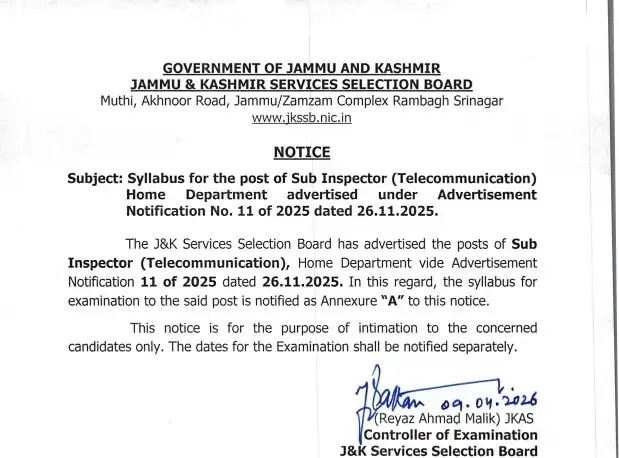
The Jammu and Kashmir Services Selection Board (JKSSB) has officially released the syllabus for the post of Sub-Inspector (Telecommunication) under the Home Department. This notification is issued in reference to Advertisement Notification No. 11 of 2025 dated 26 November 2025.
Candidates who have applied or are planning to appear for this prestigious recruitment must carefully review the detailed syllabus and exam pattern to prepare effectively. The syllabus outlines both general and technical subjects, making it essential for aspirants to plan their preparation strategically.
JKSSB SI Telecommunication 2026: Overview
The recruitment for Sub-Inspector (Telecommunication) in J&K Police is a highly competitive process. As per the official notice, the written examination syllabus has been released as Annexure “A” for candidates’ reference.
Key Highlights:
- Post Name: Sub-Inspector (Telecommunication)
- Department: Home Department, J&K Police
- Notification No.: 11 of 2025
- Exam Mode: Objective Type (MCQs)
- Total Questions: 100
- Total Marks: 200
- Duration: 120 minutes
- Negative Marking: 0.5 marks for each wrong answer
JKSSB SI Telecommunication Exam Pattern
According to the official document (Page 2), the written test will consist of multiple-choice questions. Each question carries 2 marks, and candidates will be penalized for incorrect answers.
Exam Structure:
Part A – General Awareness, Aptitude & Communication (60 Marks)
| Subject | Marks |
|---|---|
| General Knowledge & Current Affairs | 20 |
| GK with Special Reference to J&K UT | 10 |
| General English & Communication | 10 |
| General Intelligence & Reasoning | 10 |
| Basic Numeracy | 10 |
Part B – Technical/Professional Knowledge (140 Marks)
| Subject | Marks |
|---|---|
| Engineering Mathematics & Signal Fundamentals | 10 |
| Electronic Devices, Analog Circuits & Network Theory | 20 |
| Digital Electronics & Microprocessors | 20 |
| Communication Systems | 20 |
| Computer Science & Networking | 20 |
| Cyber Security & Legal Framework | 10 |
| IT Systems & e-Governance | 10 |
| Database Management Systems | 10 |
| IoT, Embedded Systems & Mechatronics | 10 |
| AI, Data Science & Automation | 10 |
Total Marks: 200
Detailed Syllabus Breakdown
The syllabus is divided into two major sections: Part A (General) and Part B (Technical). Below is a simplified yet comprehensive breakdown.
Part A: General Awareness, Aptitude & Communication
1. General Knowledge & Current Affairs
This section tests awareness of:
- National and international events
- Indian economy, budget, and schemes
- Scientific developments
- Space and nuclear programs
- Indian polity and constitution
- Disaster management and climate change
2. GK with Special Reference to J&K UT
- History of Jammu & Kashmir
- Geography including rivers, climate, flora, and fauna
- J&K Reorganisation Act, 2019
3. General English & Communication Skills
- Grammar (tenses, articles, prepositions)
- Active/passive voice
- Direct and indirect speech
- Vocabulary (synonyms, antonyms, idioms)
- Reading comprehension
- Professional communication & email etiquette
4. General Intelligence & Reasoning
- Analogies
- Coding-decoding
- Series (number/letter)
- Venn diagrams
- Syllogisms
- Logical reasoning and pattern recognition
5. Basic Numeracy
- Percentages, ratio & proportion
- Profit and loss
- Time, speed, distance
- Simple & compound interest
- Data interpretation
Part B: Technical / Professional Knowledge
This section carries the highest weightage and is crucial for selection.
1. Engineering Mathematics & Signal Fundamentals
- Linear algebra (matrices, eigenvalues)
- Calculus and differential equations
- Fourier and Laplace transforms
- Signal processing basics
- Sampling theorem and convolution
2. Electronic Devices & Network Theory
- Semiconductor fundamentals
- Diodes, transistors (BJT, MOSFET)
- Amplifiers and oscillators
- KVL, KCL, network theorems
- Filters and resonance circuits
3. Digital Electronics & Microprocessors
- Number systems and Boolean algebra
- Logic gates and combinational circuits
- Flip-flops, counters
- 8085/8086 architecture
- ARM basics
4. Communication Systems
- Analog & digital communication
- Modulation techniques (AM, FM, PM)
- Error detection and correction
- Wireless communication & cellular networks
- Optical fiber communication
5. Computer Science & Networking
- OSI & TCP/IP models
- IP addressing and subnetting
- Routing protocols (RIP, OSPF)
- Data structures basics
- Operating systems fundamentals
6. Cyber Security & Legal Framework
- Malware, phishing, ransomware
- Firewalls and IDS/IPS
- Cryptography basics
- IT Act 2000
- Digital signatures
7. IT Systems & e-Governance
- Web technologies
- Cloud computing
- Data centers and disaster recovery
- Government IT infrastructure
8. Database Management Systems
- DBMS architecture
- SQL and relational databases
- Normalization
- Transaction processing
9. IoT, Embedded Systems & Mechatronics
- IoT architecture
- Embedded systems
- Robotics basics
- Sensors and actuators
- Surveillance systems like CCTV & RFID
10. AI, Data Science & Automation
- Basics of Artificial Intelligence
- Applications in governance
- Big data analytics
- Ethical concerns in AI
Preparation Tips for JKSSB SI Telecommunication
- Focus on Technical Subjects: Since Part B carries 140 marks, prioritize engineering topics.
- Revise Basics: Strengthen fundamentals of electronics and communication.
- Practice MCQs: Solve previous papers and mock tests regularly.
- Stay Updated: Read daily current affairs for Part A.
- Time Management: Practice solving papers within 120 minutes.
Why This Syllabus is Important?
Understanding the official syllabus helps candidates:
- Avoid unnecessary topics
- Focus on scoring areas
- Plan a structured study schedule
- Improve accuracy and reduce negative marking
Conclusion
The JKSSB SI Telecommunication Syllabus 2026 provides a clear roadmap for aspirants preparing for the examination. With a balanced mix of general awareness and technical knowledge, candidates must adopt a smart and disciplined approach to succeed.
Make sure to download the official syllabus PDF and go through it thoroughly before starting your preparation.
📥 Download Official PDF
👉 Download Syllabus PDF: Click here