
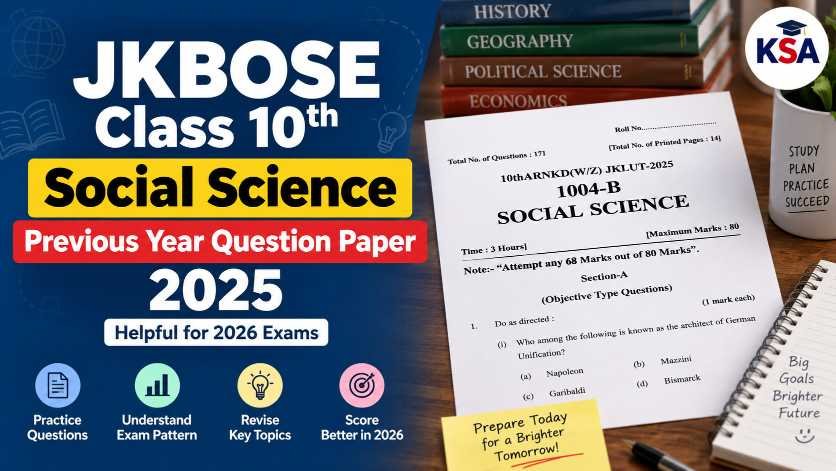
The JKBOSE Class 10th Social Science Previous Year Question Paper 2025 provides students with a complete question paper for practice and revision ahead of the 2026 examinations. The paper carries a maximum of 80 marks and contains questions covering different areas of Social Science, including history, geography, political science, economics, Jammu and Kashmir-related topics, disaster management, and map-based questions.
For students preparing for the JKBOSE Class 10th Social Science examination in 2026, working through a previous year question paper can help them become familiar with the structure and wording of questions. The 2025 paper also provides an opportunity to practise objective, short-answer, long-answer, extract-based, and map-based questions.
Question Paper Pattern and Maximum Marks
The 2025 Social Science question paper is identified as 10th ARNKD(W/Z) JKLUT-2025, 1004-B Social Science. The paper has a maximum of 80 marks. The instructions state that students should attempt 68 marks out of 80 marks.
The paper is divided into multiple sections. These include Section-A for objective-type questions, Section-B for short-answer questions, Section-C for long-answer questions, and Section-D for map-based questions. This structure gives students a clear example of the different forms in which questions can appear.
Section-A: Objective-Type Questions
The first section contains objective-type questions carrying one mark each. The questions use different formats, including multiple-choice questions, fill-in-the-blanks, and true-or-false statements.
The history-related questions include topics such as German unification, Hind Swaraj, the Poona Pact, the Tenancy Amendment Act, and the work titled Maefi Nama. The paper also includes a question concerning the establishment of the Jammu and Kashmir University.
Geography-related objective questions cover subjects such as plantation crops, shifting cultivation, minerals, renewable energy, wind power, and other geographical concepts. One question asks students to identify the state with the largest wind power cluster, while another focuses on the rocks in which minerals are deposited and accumulated.
The objective section also includes questions related to democracy, inequalities, the Instrument of Accession, the Jammu and Kashmir Reorganisation Act, sapphire in the Paddar area of Kishtwar, the primary sector’s share in the GSDP of J&K, earthquake terminology, and the full form of SDRF.
Section-B: Short-Answer Questions
Section-B contains short-answer-type questions. The paper instructs students to answer these questions in 40 to 60 words, with each question carrying 3 marks.
The questions cover several important Social Science themes. Among them are questions on why Gandhiji decided to withdraw the Non-Cooperation Movement, the historical impact of technology on food availability, and the increase in industrial production in India during the First World War.
Other questions ask about the Bretton Woods Agreement, why some industrialists in nineteenth-century Europe preferred hand labour over machines, and the characteristics of intensive subsistence farming. Students are also asked about basic industries and examples, constitutional provisions that make India a secular state, and the meaning and characteristics of a political party.
The paper further includes questions on the economic importance of horticulture in Jammu and Kashmir, the role of the community during a disaster, and differences between local government before and after the Constitutional Amendment in 1992.
Section-C: Long-Answer Questions
Section-C is the long-answer portion of the paper. Students are instructed to answer the questions in 100 to 130 words, with each question carrying 5 marks.
The questions require students to explain and discuss topics rather than provide only short factual responses. The paper asks about the meaning of the 1848 revolution of the liberals and the political, social, and economic ideas supported by the liberals.
Other questions deal with land-use patterns in India and why land under forests has not increased much since 1960-61, as well as reasons for power sharing with an example from the Indian context. Another question focuses on the role of tourism in generating employment in Jammu and Kashmir.
Extract-Based Question on Print and Society
The paper also contains an extract-based question related to the introduction of printing and its impact on the production and availability of books. The extract discusses how books became available in greater numbers and at lower prices and refers to public libraries and the spread of access to books.
The extract further discusses writings on caste discrimination and mentions Jyotiba Phule, B.R. Ambedkar, and E.V. Ramasamy Naicker. It also refers to local protest movements and the creation of journals and tracts.
The questions based on the extract ask how book production became easier and cheaper, how access to books expanded for poor people, and who wrote Gulamgiri and what its theme was.
Download PDF Link: Click here
Section-D: Map-Based Questions
The final section is dedicated to map-based questions. Students are asked to indicate specific locations on an outline map of India. The listed locations are Banihal Railway Station, Tuticorin Port, and Raja Sansi International Airport.
The paper also contains a world-map question requiring students to shade and label the federal countries Brazil and Australia.
Why Students Can Practise the 2025 Paper for 2026 Preparation
The JKBOSE Class 10th Social Science 2025 question paper gives students a complete practice paper covering the different question formats used in the paper. By attempting it, students can practise objective questions, short answers, long answers, extract-based questions, and map-based questions in one paper.
Students preparing for the 2026 examination can use the paper as a revision resource to understand how questions are presented and how answers are expected to be structured. The short-answer section specifically provides a 40–60-word guideline, while the long-answer section specifies 100–130 words.
The paper also demonstrates the broad range of subjects that can be covered in Social Science, from history and geography to political science, economics, Jammu and Kashmir-related topics, disaster management, and map work.
Download JKBOSE Class 10th Social Science Previous Year Question Paper 2025 PDF
Students can use the JKBOSE Class 10th Social Science Previous Year Question Paper 2025 PDF provided with this article for practice and revision. The 14-page paper contains the complete set of questions, from the objective section on the opening pages through the short-answer and long-answer sections to the extract-based and map-based questions at the end.
Practising the complete paper can help students become familiar with its structure and question formats while preparing for the 2026 examination.