
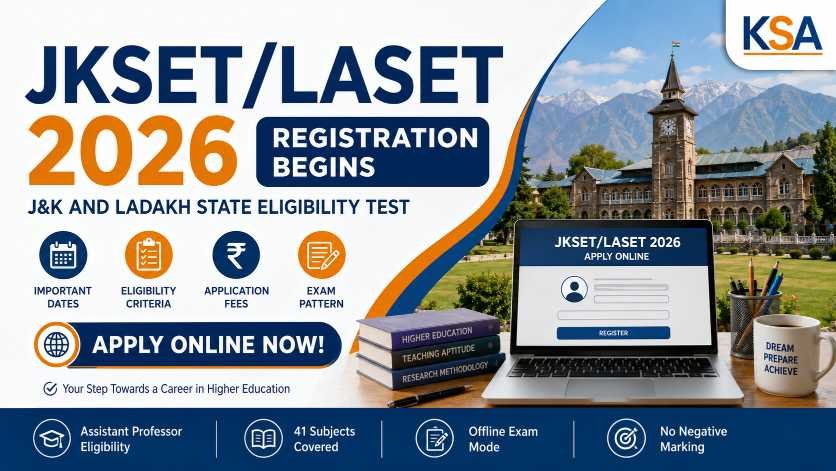
The University of Kashmir has released the detailed Information Bulletin for JKSET LASET 2026, setting the process in motion for candidates aspiring to become eligible for appointment as Assistant Professors in universities and colleges across the Union Territories of Jammu & Kashmir and Ladakh.
The State Eligibility Test will be conducted by the University of Kashmir, which is serving as the Nodal SET Agency. According to the official bulletin, the JKSET/LASET 2026 examination will be conducted on October 25, 2026, across designated examination centres in Kashmir, Jammu and Ladakh.
Online applications commenced on July 24, 2026, while candidates can submit their application forms without a late fee until August 20, 2026. Those unable to complete the process within the normal application window will have an additional opportunity to apply with a late fee until August 25, 2026.
The examination is particularly important for postgraduate candidates looking to pursue careers in higher education. JKSET is meant for the Union Territory of Jammu & Kashmir, while LASET applies to the Union Territory of Ladakh. The 2026 examination will be conducted in 41 subjects, covering Sciences, Humanities, Languages, Social Sciences and several professional disciplines.
JKSET/LASET 2026: Important Dates
Candidates planning to appear in the examination should keep track of the application and examination schedule. The official Information Bulletin specifies the following timeline:
| Event | Date |
|---|---|
| JKSET/LASET 2026 Notification | July 17, 2026 |
| Online Application Start Date | July 24, 2026 |
| Last Date to Apply Without Late Fee | August 20, 2026 |
| Last Date to Apply With Late Fee | August 25, 2026 |
| Admit Card Download | October 8, 2026 |
| JKSET/LASET 2026 Exam Date | October 25, 2026 |
| Provisional Answer Key | To be announced later |
Applicants have been advised not to wait until the final day to submit their forms. Last-minute traffic, payment issues or network problems can create unnecessary difficulties, particularly when the application deadline is approaching.
What is JKSET/LASET 2026?
The State Eligibility Test (SET) determines the eligibility of candidates for appointment as Assistant Professors in universities and colleges.
The Higher Education Departments of the UT of Jammu & Kashmir and UT of Ladakh have authorised the University of Kashmir to act as the Nodal Agency for conducting the examination.
Candidates qualifying under the Assistant Professor category can also become eligible for admission to PhD programmes, subject to applicable rules and other requirements.
There is, however, an important distinction candidates should understand. Qualifying JKSET/LASET does not provide Junior Research Fellowship (JRF). The examination determines eligibility for Assistant Professor and can also be relevant for PhD admission as specified in the bulletin.
Furthermore, qualifying the examination does not automatically amount to appointment as an Assistant Professor. Candidates will still have to satisfy the academic qualifications and recruitment requirements prescribed by the UGC and the respective university, college or government authority.
JKSET/LASET 2026 Eligibility Criteria
Before paying the examination fee, candidates should carefully verify whether they satisfy the eligibility requirements.
Candidates who have secured at least 55% marks, without rounding off, in their Master’s Degree or equivalent examination from a university or institution recognised by the UGC are eligible to apply.
Relaxation has been provided to specified categories.
Candidates belonging to OBC Non-Creamy Layer, SC, ST, PwD and Third Gender categories are eligible with at least 50% marks in the Master’s Degree or equivalent examination.
The qualification can be in Sciences, Humanities, including languages, Social Sciences or other relevant disciplines covered under the examination.
Can students pursuing a Master’s Degree apply?
Yes. Candidates whose Master’s Degree examination result is awaited, as well as those currently appearing in the qualifying examination, can apply provisionally.
Such applicants are required to upload a Bona Fide Certificate signed by the concerned Head of Department, College or Institute.
Candidates appearing in an Integrated Master’s Degree or equivalent programme must be studying in the 7th, 8th, 9th or 10th semester.
These candidates will have to complete their postgraduate qualification with the required percentage within two years from the date of declaration of the JKSET/LASET result. Failure to fulfil this condition will result in disqualification.
Relaxation for PhD holders
Candidates possessing a PhD degree whose Master’s-level examination was completed on or before September 19, 1991, irrespective of the date on which the result was declared, are entitled to a relaxation of five percentage points.
For such candidates, the eligibility threshold is reduced from 55% to 50% marks.
Candidates Should Apply in Their Postgraduate Subject
As a general rule, candidates are required to appear in the subject in which they completed their postgraduate degree.
Where a candidate’s postgraduate subject is not included among the JKSET/LASET subjects, the official bulletin advises such candidates to appear in the corresponding UGC-NET, UGC-CSIR NET or ASRB NET, as applicable.
Candidates holding foreign degrees or postgraduate diplomas outside the Indian university system should also ensure that their qualifications have the necessary equivalence. The bulletin advises such candidates to obtain confirmation from the Association of Indian Universities (AIU), New Delhi.
JKSET/LASET 2026 Application Fee
The application fee varies according to the candidate’s category.
| Category | Without Late Fee | With Late Fee |
|---|---|---|
| Unreserved | ₹1,200 | ₹1,800 |
| RBA/ALC-IB/OBC/EWS | ₹900 | ₹1,500 |
| SC/ST (I & II)/Transgender/PwD with 40% disability | ₹700 | ₹1,300 |
Applicable service or processing charges and GST charged by the bank or payment gateway may have to be paid in addition to the examination fee.
Candidates from states other than Jammu & Kashmir and Ladakh who belong to reserved categories will be treated as Open Merit/Unreserved candidates for the examination, as stated in the official bulletin.
Reservation Policy for JKSET/LASET 2026
Reservation for candidates applying for JKSET will be governed by the existing reservation policy of the UT of Jammu & Kashmir, while candidates applying for LASET will be covered by the reservation policy applicable in the UT of Ladakh.
A candidate seeking reservation must possess the required valid category certificate and domicile certificate by the cut-off date, which is the last date for submission of the online application.
Certificates that are under process or have expired will not be considered.
Candidates should therefore verify their category documents well before submitting the online form instead of assuming that certificates can be produced later.
JKSET/LASET 2026 Subjects
The examination will be conducted in 41 subjects/areas. Paper I, the General Paper on Teaching and Research Aptitude, is compulsory for everyone.
The subjects include:
- Chemical Sciences
- Earth, Atmospheric, Ocean and Planetary Sciences
- Life Sciences
- Mathematical Sciences
- Physical Sciences
- Arab Culture and Islamic Studies
- Arabic
- Buddhist, Jaina, Gandhian & Peace Studies
- Commerce
- Computer Science & Applications
- Dogri
- Economics
- Education
- Electronic Science
- English
- Environmental Sciences
- Geography
- Hindi
- History
- Home Science
- Kashmiri
- Law
- Library & Information Science
- Linguistics
- Management
- Mass Communication and Journalism
- Music
- Persian
- Philosophy
- Physical Education
- Political Science
- Psychology
- Public Administration
- Punjabi
- Sanskrit
- Social Work
- Sociology
- Urdu
- Tourism Administration & Management
- Anthropology
- Women Studies
The inclusion of subjects ranging from traditional languages and social sciences to science disciplines and professional fields means the examination covers a broad section of postgraduate candidates across J&K and Ladakh.
JKSET/LASET 2026 Exam Pattern
The JKSET/LASET 2026 examination will be conducted in offline mode.
There will be two papers, and both will contain objective-type questions, including multiple-choice, matching, and assertion-and-reasoning questions.
Paper I
Paper I is common to all candidates and is designed to assess teaching and research aptitude.
It will primarily test areas such as reasoning ability, reading comprehension, divergent thinking and general awareness.
Number of Questions: 50
Total Marks: 100
Duration: 60 minutes
Timing: 11:30 AM to 12:30 PM
Each correct response carries two marks.
Paper II
Paper II is based on the subject selected by the candidate and is intended to assess domain knowledge.
Number of Questions: 100
Total Marks: 200
Duration: 120 minutes
Timing: 12:50 PM to 2:50 PM
There will be a 20-minute interval between Paper I and Paper II for collection and distribution of examination material.
Importantly, there is no negative marking for incorrect answers.
Candidates must appear in both papers. A candidate who does not appear in Paper I will not be permitted to appear in Paper II.
Responses will be marked on Optical Mark Reader (OMR) sheets supplied with the test booklets.
JKSET/LASET 2026 Syllabus
The syllabus for JKSET/LASET 2026 will be the same as the UGC/CSIR NET syllabus, depending on the subject.
For science subjects including Mathematical Sciences, Physical Sciences, Chemical Sciences, Life Sciences and Earth Sciences, the syllabus corresponds to the CSIR-NET syllabus, although the examination pattern will follow the format described by the SET Agency.
Candidates should download the latest syllabus for their particular subject and avoid preparing from an outdated syllabus.
JKSET/LASET 2026 Examination Centres
The examination will have three main centres:
Kashmir Centre – Code 01: Proposed sub-centres include Srinagar, Anantnag and Baramulla.
Jammu Centre – Code 02: Proposed sub-centres include Jammu, Kathua, Udhampur, Rajouri and Bhaderwah.
Ladakh Centre – Code 03: Proposed sub-centres include Leh and Kargil.
There is an important condition regarding these sub-centres. A sub-centre will be provided where the number of candidates is more than 250. If fewer than 250 candidates opt for a particular sub-centre, it may be merged with the nearest sub-centre.
Candidates should therefore treat the listed cities as proposed sub-centres rather than assuming that every listed location will necessarily operate as an examination venue.
How to Apply for JKSET/LASET 2026
Applications are accepted online only. Applications submitted through any other mode will not be accepted.
Candidates first need to access the JKSET/LASET portal and complete registration using details including their username, mobile number—preferably a WhatsApp number—email address and password.
After registration, candidates must enter their personal details, address, academic qualifications, examination centre preferences and the subject in which they want to appear.
Before final submission, every entry should be checked carefully. Details such as the candidate’s name, date of birth, category, domicile UT, postgraduate subject and examination centre can have a direct impact on candidature.
Only one application form should be submitted by each candidate.
Documents Required While Applying
Applicants should keep their documents ready before starting the application process. The bulletin requires candidates to upload a recent passport-size photograph and scanned signature along with other applicable documents.
A recent photograph should be in JPG/JPEG format, clearly show the candidate’s face and have a plain white background.
Depending on the candidate’s circumstances, the following may also be required:
- Valid reserved category certificate, where applicable
- Domicile certificate
- Bona Fide Certificate for candidates pursuing a Master’s Degree
- Other relevant eligibility/category documents
Candidates should retain their application form and fee receipt after completing the process.
There is no requirement to submit a hard copy of the application form, fee receipt or category certificate to the SET office before the examination.
Qualified candidates will subsequently have to undergo physical verification of their eligibility and category-related documents.
JKSET/LASET 2026 Qualifying Criteria
Merely obtaining the minimum percentage does not necessarily guarantee qualification.
According to the official result methodology, the total number of candidates to be qualified for eligibility as Assistant Professor will be equal to 6% of the candidates who appeared in both papers.
For consideration, candidates belonging to the Unreserved/EWS-General category must secure at least 40% aggregate marks in both papers taken together.
Candidates belonging to other reserved categories must secure at least 35% aggregate marks across the two papers.
The available qualifying slots are then allocated according to the applicable reservation policy and the prescribed UT-wise, subject-wise and category-wise methodology.
This means the eventual qualifying cut-off may differ across subjects and categories.
Provisional Answer Key and Challenge Facility
Following the examination, the JKSET Agency will display provisional answer keys on its website.
Candidates will be given an opportunity to challenge the provisional answer key. The bulletin states that the keys are likely to remain available for challenges for around two to three days, with the exact schedule to be notified separately.
A candidate challenging an answer will have to pay a non-refundable processing fee of ₹200 per answer key challenged.
Only paid challenges submitted through the prescribed online facility within the stipulated period will be considered. Challenges without justification or supporting evidence, or those submitted through other modes, will not be entertained.
The Agency’s decision after examining the challenges will be final, and the result will be prepared on the basis of the final answer keys.
No Re-Evaluation of JKSET/LASET Result
Candidates should also note that there is no provision for re-evaluation or re-checking of the JKSET/LASET result.
The Information Bulletin states that correspondence seeking re-evaluation or re-checking will not be entertained.
Admit Card From October 8
The JKSET/LASET 2026 admit card is scheduled to become available for download from October 8, 2026.
Candidates will need to carry a printed copy of the admit card to the examination centre along with an original, valid and non-expired authorised photo ID.
Accepted photo identification includes documents such as Aadhaar Card with photograph, PAN Card, Driving Licence, Voter ID and Passport.
The name on the photo identification should match the name printed on the admit card.
Candidates claiming PwD relaxation should also carry the relevant certificate issued by the competent authority.
Why Candidates Should Read the Information Bulletin Carefully
For many candidates, the State Eligibility Test is a significant step towards an academic career. Small mistakes in the application—selecting the wrong subject, entering an incorrect category or uploading an invalid certificate—can create serious problems later.
The University has made it clear that candidates are responsible for ensuring their eligibility and for providing accurate information.
Applicants should therefore avoid relying solely on social media posts or brief summaries. Before submitting the form and paying the fee, they should read the official Information Bulletin, particularly the sections dealing with eligibility, reservation, subject selection and document requirements.
The official bulletin also contains detailed instructions regarding PwD provisions, examination-day conduct, unfair means, result preparation, certificate validity and document verification.
JKSET/LASET 2026: Key Takeaway
The JKSET LASET 2026 application process is an important opportunity for postgraduate candidates seeking Assistant Professor eligibility in Jammu & Kashmir and Ladakh.
Applications opened on July 24, and the normal registration window will remain available until August 20, 2026. Applications with a late fee can be submitted until August 25, while the examination itself is scheduled for October 25, 2026.
With the test being conducted across 41 subjects, candidates from a wide range of academic disciplines can participate, provided they meet the prescribed eligibility conditions.
Applicants should complete registration well before the deadline, carefully verify their subject and category, upload valid documents and retain copies of the submitted application and payment receipt.
Official JKSET/LASET 2026 Notification PDF
Candidates are strongly advised to read the complete official Information Bulletin before applying.