
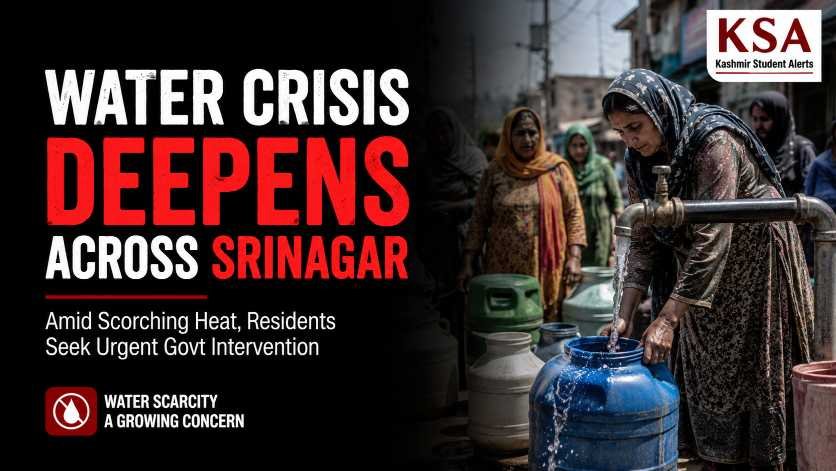
Water Crisis Deepens Across Srinagar Amid Scorching Heat, Residents Seek Urgent Govt Intervention
Commissioner Secretary H&UDD says, “40% of Srinagar’s water is being used to irrigate lawns and gardens, Srinagar lacks separate irrigation system; Govt to shift lawns to treated STP water”
Srinagar, July 7: Amid soaring temperatures, a severe drinking water crisis has gripped several parts of Srinagar, with residents from both downtown and uptown localities alleging disruption in potable water supply for more than a week and urging the authorities to restore normal services immediately.
Residents from Habba Kadal, Karfali Mohalla, Chotta Bazar, Guru Bazar, Qamarwari, Karan Nagar, Batmaloo, Hawal, Islamia college Gowjwara and Natipora told news agency JKNS that they have been facing acute shortages for over a week, forcing families to depend on private sources, neighbours and purchased water for their daily needs.
Javed Ahmad Gooru, a resident near Islamia College, Srinagar, told JKNS that, “We have been facing a drinking water crisis for more than a week. People are spending hours arranging water for basic household needs. In this scorching heat, it has become extremely difficult to manage daily life. The authorities must restore the supply without any further delay.”
Shafiq Ahmad, a resident of Karfali Mohalla, Habba Kadal, said there has been no regular water supply in the locality.
“There is no proper drinking water in our area. Families are suffering badly and even arranging water for drinking has become a daily struggle. The authorities should restore the supply without any further delay,” he said.
Nazir Khan, a resident of Chotta Bazar, Karan Nagar, said the crisis has disrupted normal life.
“We have tap connections and pay water bills regularly, but there is hardly any water. We are now forced to purchase drinking water from outside, which is becoming an additional financial burden,” he said.
Umaiya, a resident of Faizabad Colony, Natipora, said the shortage has affected every household.
“We have small children and elderly people at home. Managing without water in this heat has become extremely difficult. The government should treat this as an emergency,” she said.
Umaan, a resident of Batmaloo, said residents have repeatedly approached the concerned department but the problem continues.
“We have submitted complaints several times, but the supply remains irregular. Water is a basic necessity and people should not be forced to suffer like this,” he said.
When contacted, Executive Engineer, PHE Division Srinagar, Er. Ambreen, told JKNS that the issue appeared to be local in nature and would be resolved shortly.
However, when informed that the drinking water crisis had persisted in several localities for more than a week, the official did not provide any specific reason for the prolonged disruption or a definite timeline for restoration.
Meanwhile, speaking to reporters in Srinagar, Commissioner Secretary, Housing and Urban Development Department (H&UDD), Mandeep Kaur, as per JKNS, said that the city’s water supply system faces two distinct challenges — the availability of drinking water and its rational utilisation.
She said Srinagar currently lacks a separate infrastructure for supplying water for drinking purposes and for irrigating lawns and gardens, with both uses depending on the same potable water supply network.
“This is the biggest problem with our water supply system. In many other cities, separate arrangements exist for drinking water and irrigation. In Srinagar, that infrastructure is still missing,” she said.
Citing a recent assessment, Kaur said nearly 40 percent of Srinagar’s water supply is used for irrigating lawns and gardens, for which no payment is made. “This is what is called non-revenue water. At the same time, the issue of user charges also exists. Government resources are limited, which is why citizens’ contribution and responsible use of water are essential in every sector,” she said.
The Commissioner Secretary said the government is working on two major initiatives to address the issue. One is the reuse of treated water from Sewage Treatment Plants (STPs) for irrigation and commercial purposes so that potable water is not used where recycled water can suffice.
“Wherever treated water can be used for irrigation or commercial purposes, drinking water supply should not be provided, and potable water connections in such cases should eventually be discontinued. This is the practice followed in many cities. Overall rationalisation of water supply is being worked upon,” she said.
She added that wherever water supply issues are reported, the administration is ensuring tanker-based supply. “If there are areas where shortages have been reported, as you have pointed out, we will ensure that water supply is provided there,” Kaur said. (JKNS)